

When a client says "let me think about it," the clinical work is already done. The diagnosis is made, the treatment plan is built, and the conversation has happened. The only thing standing between your practice and that revenue is a payment gap at checkout.
You already paid for that visit in staff time, exam room time, and doctor hours. When the client walks, those costs stay on your P&L without the matching revenue. The pattern shows up in monthly numbers whether practices track it or not.
Scratchpay estimates that a practice declining roughly 10% of treatment revenue to payment barriers loses about $100,000 a year at $1M in revenue — $200,000 at $2M, $400,000 at $4M.³ Independent research supports the direction: a 2025 Gallup survey found 52% of U.S. pet owners had declined or skipped recommended veterinary care, with 70% citing cost as the primary barrier.⁴ A study published in the Journal of the American Veterinary Medical Association found that practices offering third-party financing reported 22% more revenue than those without it.⁵
One multi-location veterinary group in the Phoenix area added Scratch Pay™ to their checkout process, approved over 5,000 clients for payment plans, and generated $3.5M in incremental revenue from clients who were already walking through the door.⁶
Most practices offer some form of payment options. The quality varies widely, and the gap shows up in approval rates.
Approval rates that reflect your actual client base matter most. At one multi-location veterinary group, 81% of applicants with Fair or better VantageScore credit were approved through Scratch Pay's platform. At a Los Angeles practice, 903 applicants were approved at an average plan size of $1,584.⁷
A checkout process the front desk can actually run is just as important. Scratch Pay applications are mobile-first and decisioned in seconds — no paper forms, no holding up the line during the lunch rush.
Reducing reconciliation work rounds out the picture. Scratch Checkout™ is designed to work alongside your practice management software without requiring a PIMS integration — invoice totals flow to the terminal and end-of-day reconciliation runs in the background. Scratchpay reports average annual savings of around $11,500 for clinics on common workflows.⁸
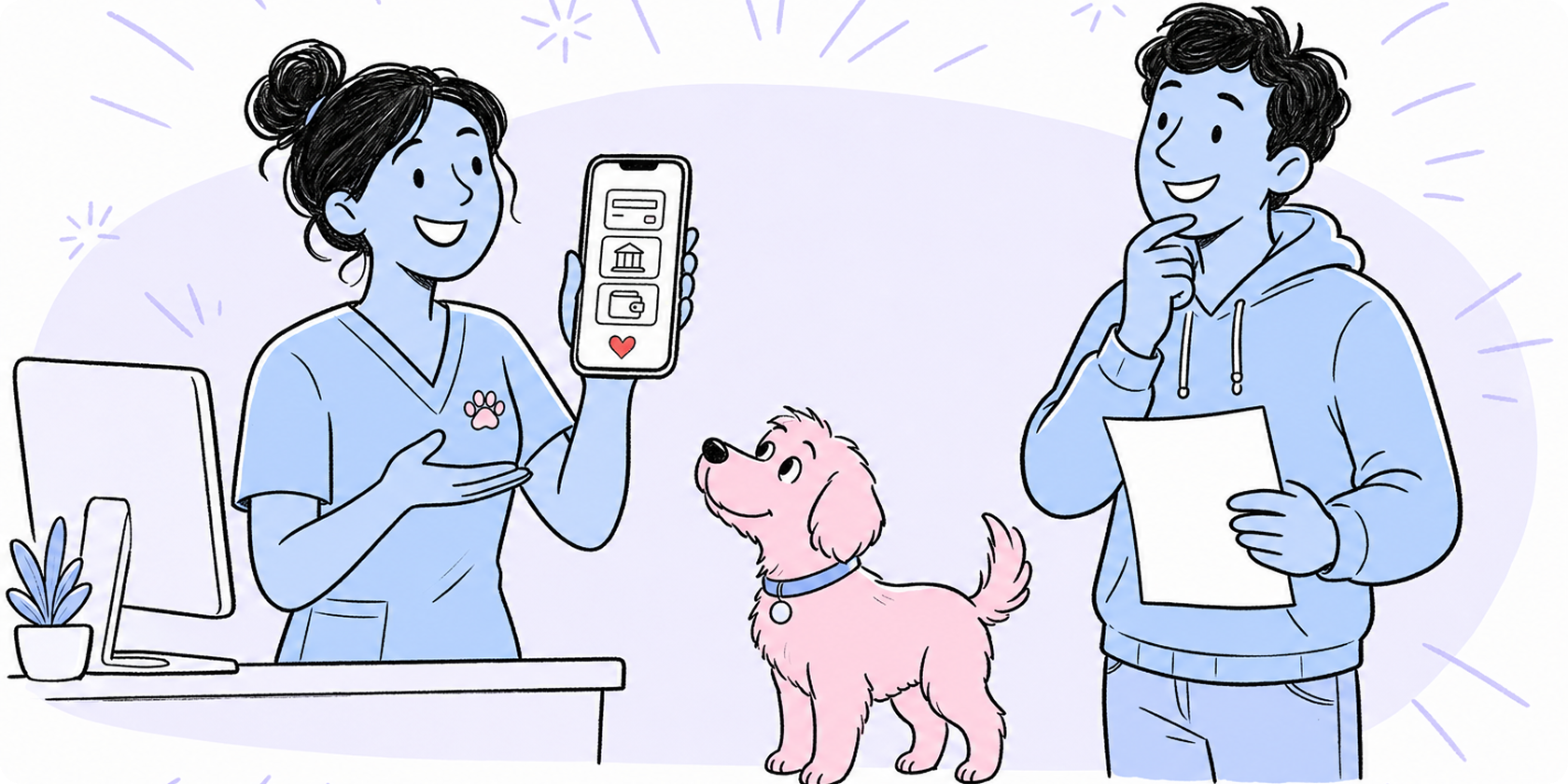
Processing fees are an operating expense most practices accept without scrutiny. The math is worth running.
A practice with $900K in annual card volume pays around $22,500 a year at a 2.5% effective rate — $112,500 over five years. At $1.8M that climbs to $45,000 a year; at $3.6M it reaches $90,000. Industry benchmarks put the typical rate for veterinary practices between 2.5% and 3.5% per transaction, with some practices paying closer to 3%–4%.⁹
Scratchpay reports that clinics on Scratch Checkout save around $900 a month on average, or roughly $10,800 a year.¹⁰ Practices that add surcharging — passing the card fee to clients who choose to pay by credit — can reach $45,000 in annual savings at approximately $1.5M in annual card volume.¹¹ Surcharging is currently legal and operational in 47 states (excluding Connecticut, Massachusetts, Maine and Puerto Rico), and capped at 2% in Colorado.¹².
One animal hospital was paying a 2.91% effective rate, totaling $2,968 a month before switching — nearly $36,000 a year going to a processor that wasn't built for veterinary medicine and didn't connect to their software.¹³
.png)
Many practices already offer some form of deferred-interest financing. Staff know how to explain it, and for the right client it works fine. The limitations show up in day-to-day practice. Decline rates run higher than most owners realize, which leaves them without a Plan B. The deferred-interest terms can confuse pet owners who don't always read the terms and conditions closely. Settlement gets delayed because the practice doesn't get paid until the financing partner clears the transaction.
Offering Scratch Pay alongside or in place of those programs gives you a product that approves more people, with clearer terms, and pays the practice upfront. Both client access and cash flow improve at the same time. The practices that close the most declined care make sure their front desk has a fast, confident answer ready when a client says, "I want to do this, but I'm not sure I can afford it right now."
¹ Emergency veterinary visits typically cost $800–$1,500 for standard presentations; complex cases exceed $5,000. Money.com: https://money.com/how-much-is-an-emergency-vet-visit/
² Bankrate Annual Emergency Savings Report, January 2025. CBS News: https://www.cbsnews.com/news/saving-money-emergency-expenses-2025/ — Fortune: https://fortune.com/article/bankrate-emergency-savings-report-2025
³ Scratchpay internal estimate. Methodology: assumes ~10% of annual revenue is lost to clients who decline treatment due to payment barriers. Not drawn from a third-party study. Independent context in footnotes 4 and 5.
⁴ Gallup, "52% of U.S. Pet Owners Skipped or Declined Veterinary Care," January 2026: https://news.gallup.com/poll/659057/pet-owners-skipped-declined-veterinary-care.aspx
⁵ National Commission on Veterinary Economic Issues data, as cited in: Journal of the American Veterinary Medical Association, "Could offering a variety of payment options lead to more owners accepting care recommendations?," December 2025: https://avmajournals.avma.org/view/journals/javma/263/S3/javma.25.06.0380.xml
⁶ Scratchpay customer case study, Phoenix-area multi-location group. Results are from a specific practice; contact Scratchpay for the full case study.
⁷ Scratchpay platform data from referenced practices. Approval rates vary by applicant credit profile, loan terms, and practice type.
⁸ Scratchpay internal analysis. Savings reflect reduced reconciliation overhead for clinics using Scratch Checkout on common practice workflows. Individual results vary.
⁹ AAHA Trends, "Improving Cash Flow and Eliminating Credit Card Fees in Veterinary Practices," May 2026: https://www.aaha.org/trends-magazine/publications/improving-cash-flow-and-eliminating-credit-card-fees-in-veterinary-practices/ — Vellis Financial, "Veterinary Credit Card Processing Fees": https://www.vellis.financial/blog/vellis-news/veterinary-credit-card-processing-fees
¹⁰ Scratchpay internal data. Savings represent the difference between a clinic's prior effective rate and Scratch Checkout's rate, across clinics that switched. Individual results vary by prior processor, card mix, and transaction volume.
¹¹ Scratchpay internal analysis. Example assumes approximately $1.5M in annual credit card volume at a 3% surcharge rate. Actual savings depend on card volume, mix, and prior effective rate.
¹² Veterinary Practice News, "Should You Implement Credit Card Surcharges?," November 2025: https://www.veterinarypracticenews.com/implementing-credit-card-surcharges/ — Nadapayments, "Vet Clinic Credit Card Processing Fees," March 2026: https://www.nadapayments.com/blog/vet-clinic-credit-card-processing-fees
¹³ Scratchpay customer data. The 2.91% effective rate is within the documented industry range. Contact Scratchpay for the full case study.




We believe patients deserve access to affordable care.
As the leader in payment processing and financing for veterinary practices across the U.S. and Canada, we’re creating products and services that simplify and add delight to patient and practice experiences.
FOLLOW US


GET THE APP


SITEMAP
If you are using a screen reader and are having difficulty using this website, please call 855-727-2395.
Scratch Pay plans in the U.S. are issued by WebBank. Scratch Pay plans in the U.S. are subject to eligibility and may not be available in all states.
In Canada, loans are issued by Scratch Financial, Inc.
Scratch Financial, Inc. DBA Scratchpay (NMLS ID 1582666).
© 2026 Scratch Financial, Inc. All Rights Reserved.
Scratch, Scratch Pay, Scratchpay, Scratch Checkout, and the Heart Logo are trademarks of Scratch Financial, Inc.