

The typical non-integrated setup looks the same in almost every practice. The front desk pulls up the invoice in your practice software, types the total into a separate terminal, runs the card, then goes back into the software and manually marks the invoice paid. Every step is a hand-off where something can go wrong, and the consequences show up at the end of every shift.
Someone on your team is comparing terminal batch reports against client records line by line — looking for discrepancies, tracking down split payments, reconciling refunds. When something doesn't match, someone has to chase it down before the day can close out.
The time adds up. Covetrus estimates that a non-integrated setup costs the average veterinary practice roughly 33 hours a month in manual payment handling — time that comes directly out of your staff's shift.² A separate industry analysis puts the figure at 80+ hours of manual data entry eliminated annually when practices move to an integrated workflow, with checkout time reduced by three to five minutes per client.³
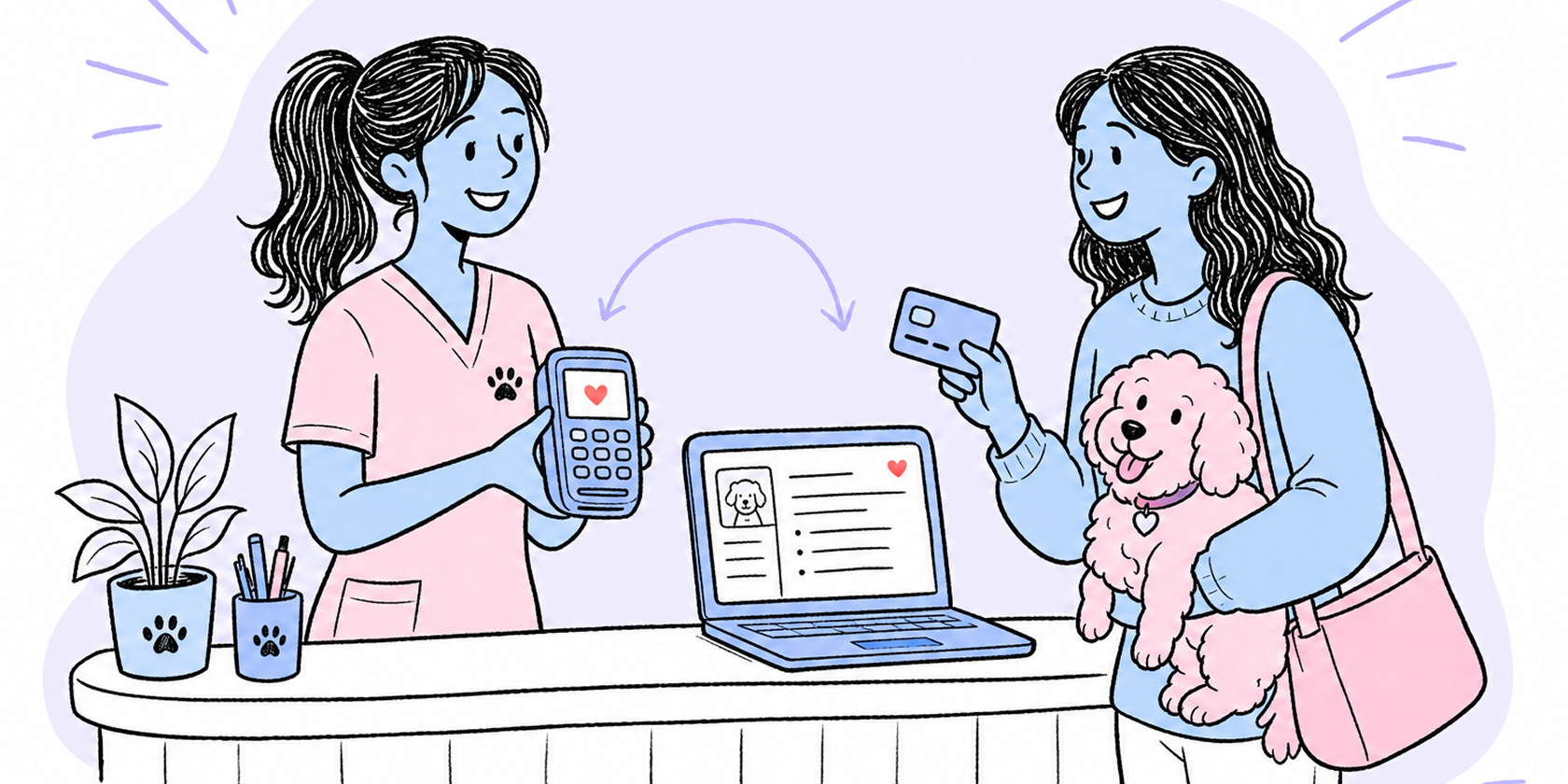
With Scratch Checkout™, the invoice total in your practice management system pushes directly to the terminal when a client is ready to check out. Your staff doesn't retype the amount or switch between screens, which removes keying errors from integrated transactions. When the payment processes, confirmation flows back into your software automatically and the client record updates without anyone touching it.
End-of-day reconciliation runs in the background instead of taking up the last 20 minutes of every shift. Text-to-pay and email-to-pay options tie back to the same workflow, so a payment collected remotely reconciles the same way one taken at the front desk does.
For payments processed through the platform:
Reconciliation time drops significantly. Without manual re-entry, the line-by-line comparison at end of shift shrinks or disappears for integrated transactions.
Keying errors are eliminated for those transactions. Staff aren't manually typing invoice amounts into a separate terminal, so miskeyed amounts and the billing conversations they trigger happen far less often.
PCI Level-1 compliance is built in. Card data is secured within Scratch's PCI Level-1 validated environment, which means practices aren't storing sensitive card data themselves.⁴ Clinics may have separate PCI compliance obligations depending on how they handle cardholder data outside the Scratch platform.⁵
The rate is flat and easy to verify. You pay for what you process. No tiered rate surprises on your monthly statement.
A general-purpose processor will tell you they support practice management software. What that usually means is a generic connector designed around a handful of the largest systems — not around how a veterinary front desk actually operates.
Scratch Checkout was built for veterinary practices. The platform handles split payments across multiple pets on a single client account, deposits applied to estimates, refunds tied to specific line items, and high-volume checkout windows. Practices that switch save an average of $900 a month on processing fees — and for practices with higher card volume, the savings are proportionally larger.¹
¹ Scratchpay internal data. Based on average monthly savings on processing fees for practices that switched to Scratch Checkout in the 12 months ending November 1, 2023. Individual savings vary by prior effective rate, card volume, and transaction mix.
² Covetrus, "How Much Is Non-Integrated Payment Processing Costing Your Practice?" An average practice processing ~500 credit card transactions per month spends approximately 50 hours monthly on payment handling under a non-integrated setup; integration reduces that by an estimated 33 hours. https://software.covetrus.com/veterinary-insights/blog/client-solutions/save-time-with-integrated-veterinary-payment-processing/
³ Vida AI, "Veterinary Credit Card Processing: Complete Guide for Practices," January 2026. https://vida.io/blog/veterinary-credit-card-processing
⁴ PCI Level-1 is the highest level of PCI DSS compliance, covering service providers that process more than 300,000 transactions annually. Source: PCI Security Standards Council, https://www.pcisecuritystandards.org/standards/pci-dss/
⁵ Scratchpay Payment Services Agreement: https://scratchpay.com/legal/paymentprocessing




We believe patients deserve access to affordable care.
As the leader in payment processing and financing for veterinary practices across the U.S. and Canada, we’re creating products and services that simplify and add delight to patient and practice experiences.
FOLLOW US


GET THE APP


SITEMAP
If you are using a screen reader and are having difficulty using this website, please call 855-727-2395.
Scratch Pay plans in the U.S. are issued by WebBank. Scratch Pay plans in the U.S. are subject to eligibility and may not be available in all states.
In Canada, loans are issued by Scratch Financial, Inc.
Scratch Financial, Inc. DBA Scratchpay (NMLS ID 1582666).
© 2026 Scratch Financial, Inc. All Rights Reserved.
Scratch, Scratch Pay, Scratchpay, Scratch Checkout, and the Heart Logo are trademarks of Scratch Financial, Inc.